
Pest control Donvale
Pest control in Donvale where EastLink tunnels to protect the valley
The Victorian Government built two EastLink tunnels specifically to protect Mullum Mullum Creek Valley because of its confirmed platypus, koalas, water-rats, and 85 bird species. That same exceptional wildlife environment borders Donvale's acreage properties, bush blocks, and suburban homes. Manningham is a declared termite area. Multi Pest Control services all of Donvale 3111.

Tell us a few details and our Melbourne team will get back to you quickly with the right solution.

Donvale 3111
Manningham declared termite area ✓
Acreage, bush block & suburban coverage
Koalas, platypus & water-rats confirmed in valley
12,644
residents (2021 Census)
26 parks
10.8% of 12.7 km²
18.5 km
Mullum Mullum Trail along creek
85 species
birds at Yarran Dheran bird mite risk
🦦 Platypus
Confirmed in creek
Ride On Magazine and kgrahamjourneys.wordpress.com both confirm platypus live in Mullum Mullum Creek. Platypus presence indicates high water quality and sustained aquatic food chains the same moist creek environment sustains rakali (water rats) and rodent populations that enter adjacent properties.
🐨 Koalas
Confirmed in valley
Manningham Council's Mullum Mullum Trail page confirms "sighting the occasional koala" along the trail. Timeout Melbourne confirms koalas at Yarran Dheran. Koalas inhabit tall manna gum woodland adjacent to Donvale properties where they live, possums also live and enter roof cavities.
🐀 Rakali (water-rats)
Confirmed in creek
Confirmed by Ride On Magazine rakali (Hydromys chrysogaster, Australian water rat) live in Mullum Mullum Creek. Rakali share habitat with introduced roof rats and Norway rats. The creek drainage network is the primary rodent travel corridor into Donvale's southern residential streets.
🦅 Eagles, falcons, owls
Confirmed in valley
Confirmed: wedge tailed eagles, falcons, and owls in the Mullum Mullum corridor. Large raptors nesting in manna gums adjacent to residential properties create bird mite migration into living areas when birds vacate nests at the end of breeding season.
🦎 Snakes
Confirmed at Yarran Dheran
Timeout Melbourne explicitly states "koalas have also been spotted in the park, as have snakes, so keep a sharp eye out." Yarran Dheran is on the border of Donvale. Eastern brown snakes and tiger snakes are active in Mullum Mullum valley relevant to property management on acreage blocks near the creek.
🦉 Yellow tailed black cockatoos
Confirmed in valley
Confirmed by Ride On Magazine and kgrahamjourneys.wordpress.com. These large, noisy birds nest in tree hollows the same hollows used by possums and sugar gliders. Their presence indicates the tree hollow density in the valley that sustains high possum populations adjacent to Donvale homes.

🐀 Rats, mice, and water-rats (rakali)
Mullum Mullum Creek hosts confirmed populations of rakali (Australian water rats, Hydromys chrysogaster) a native species that shares habitat with introduced roof rats and Norway rats. The creek drainage network provides the primary rodent travel corridor into Donvale's southern residential streets. On acreage properties, compost areas, water tanks, and fruit trees provide additional rodent harborage beyond the creek system. Autumn and winter see the highest rodent pressure as creek margins cool.
Rodent control →
🐦 Bird mites
Yarran Dheran Nature Reserve on Donvale's border hosts 85 confirmed bird species eagles, falcons, owls, night herons, rufous night herons, tawny frogmouths, and yellow-tailed black cockatoos all nest in the valley. When birds vacate nests at breeding season's end, mites migrate into living areas of adjacent homes. Donvale properties near Yarran Dheran and along the Mullum Mullum Creek corridor have the highest bird mite risk of any suburb in this guide due to confirmed raptor and large bird nesting density.
Bird proofing →
🕷️ Redback and white tail spiders
Very common on Donvale's acreage and bush block properties dry rockeries, timber outbuildings, log storage, corrugated iron sheds, and the dry southern aspects of large allotments provide ideal redback harborage. White tail spiders are common in subfloor spaces and timber framed outbuildings on larger lots. The diversity of harborage on an acreage block means spider populations are consistently higher than in standard suburban gardens.
Spider control →
🐜 Black house ants and coastal brown ants
Trailing from the moist clay soils typical of Mullum Mullum Creek's valley margins into residential and acreage homes. Acreage properties with fruit trees, compost bins, and vegetable gardens have the highest ant pressure these food sources attract and sustain very large outdoor ant colonies. Black house ants trail from compost and garden areas through the house in long lines during warmer months.
Ant control →
🐝 European wasps
Underground nesting near Mullum Mullum Creek embankments, the unmaintained sections of acreage properties, and Yarran Dheran's reserve margins. Donvale's acreage blocks with areas of unmown grass, compost, and native garden areas are particularly susceptible European wasps establish underground nests quickly in areas with low foot traffic. Same-day emergency removal available. Do not attempt to treat underground wasp nests.
Wasp removal →
🐛 Termites (Coptotermes acinaciformis)
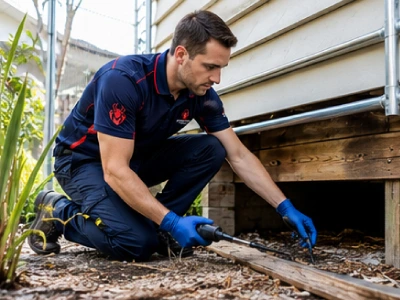
Donvale is in Manningham a confirmed declared termite local government area. The Mullum Mullum Creek gorge with its tall manna gum woodland, Candlebark, and Yellow Box tree canopy along the southern boundary provides extensive Coptotermes acinaciformis habitat directly adjacent to properties. On acreage and bush block properties, termites can reach a home anywhere on a large lot not just at the building perimeter. Annual AS 3660.2 inspections are essential for all Donvale properties.
Termite inspection →
🦝 Common brushtail possums
Abundant across all of Donvale the Mullum Mullum valley's tall manna gum woodland sustains large possum populations (the same woodlands confirmed to support koalas). Donvale's mix of acreage homes with mature overhanging trees gives possums direct roof access on virtually every property adjacent to the creek and reserve margins. New Mullum Creek estate homes have specific building design guidelines to manage the native environment but older properties often have eave gaps that possums exploit immediately.
Possum removal →
🦟 Mosquitoes
Elevated mosquito pressure in Donvale compared to non creek suburbs Mullum Mullum Creek's pools, the ponds at Yarran Dheran (confirmed: "ponds were created in the upper area and a waterfall takes any overflow down through several stages to the creek"), and any water features or retention areas on acreage properties provide mosquito breeding habitat. Properties within 500 metres of the creek or reserve ponds are at highest summer mosquito pressure.
Fly control →

Tell us a few details and our Melbourne team will get back to you quickly with the right solution.