
Pest control Croydon
Pest control in Croydon Maroondah declared termite area, gateway to the Ranges
Croydon is Melbourne's eastern gateway to the Dandenong Ranges 28,608 residents, 52 parks covering 13.7% of the suburb, and the City of Maroondah confirmed as a declared termite local government area. The same native environment that makes Croydon one of Melbourne's most liveable outer-eastern suburbs also drives its pest pressure. Multi Pest Control services all of Croydon 3136.

Tell us a few details and our Melbourne team will get back to you quickly with the right solution.

Croydon 3136
Maroondah declared termite LGA
Free Phone Consultations
Dandenong Ranges gateway
28,608
residents (2021 Census) largest in this guide
52 parks
covering 13.7% of 14.1 km²
Maroondah
declared termite LGA ✓
30 km
from Melbourne CBD
Original farmhouses and early weatherboard homes
Pre 1960 Orchard and early suburban era
High termite risk
From the 1880s, Croydon was orchard country cherries, peaches, plums, apples, and pears confirmed in the Maroondah Heritage Study. The original farmhouses and weatherboard homes built on this land used locally milled timber, often with no underfloor treatment and no subfloor ventilation. Any survivors from this era are in Maroondah's highest termite risk category.
- Termites
- Silverfish
- Rodents
- Possums
Brick veneer and weatherboard on timber subfloor
1960s 1990s Main suburban build out
Elevated termite risk
The dominant Croydon housing type 3 to 4 bedroom brick veneer and weatherboard homes on large allotments built during the suburb's main growth period. Many have original timber subfloor construction. Any chemical soil treatment from this era has expired. In Maroondah (declared termite LGA), this stock carries elevated and undocumented termite risk if not inspected in the past 12 months.
- Termites
- Rodents
- Possums
- Spiders
- Ants
Slab construction, medium density
Post 2000 Townhouses and subdivisions
Managed risk
As large Croydon allotments are subdivided, newer townhouses on slab construction have lower inherent termite risk but AS 3660.1 barriers are mandatory for all new builds in Maroondah (declared termite LGA). Buyers should always request current barrier documentation. New landscaping with mulch and retaining walls attracts ants and spiders from adjacent reserve margins.
- Ants
- Spiders
- Rodents
- Verify barrier

🐀 Rats and mice
Brushy Creek Croydon's original settlement focus, named for its tea tree banks provides the suburb's primary rodent corridor through the eastern residential streets. The Dorset Golf Course precinct (managed by Maroondah City Council on Trawalla Road) sustains rodent populations in its native grass rough areas. Croydon Main Street's 187+ food and retail businesses, Croydon Central, and Arndale Shopping Centre bin infrastructure create commercial rodent pressure in the shopping precinct.
Rodent control →
🪳 German cockroaches
Primarily a commercial pest issue in Croydon's food precincts Croydon Main Street's 187+ traders (confirmed Wikipedia), Croydon Central shopping centre on the corner of Kent and Wicklow Avenue, and Arndale Shopping Centre on Mt Dandenong Road opposite Croydon Park. Food businesses require HACCP Prerequisite Program 9 documentation for City of Maroondah council compliance under the Food Act 1984 (Vic).
Cockroach control →
🕷️ Redback and white tail spiders
Above average spider pressure across Croydon given the Dandenong Ranges proximity and 52-park coverage. Redbacks are common under outdoor furniture, in letterboxes, in dry retaining walls, and in the garden structures of Croydon's large-allotment homes. White-tail spiders inhabit the subfloor spaces of older homes, feeding on other spiders and insects. Properties backing onto any of the suburb's 52 reserves experience the highest spider pressure.
Spider control →
🐜 Black house ants and coastal brown ants
Very common in Croydon's established 1960s–1990s brick veneer homes trailing into kitchens through cracked mortar, slab edges, and plumbing penetrations. The suburb's 52 parks sustain large outdoor ant colonies that forage into adjacent residential properties along drainage paths. Homes near the Brushy Creek corridor and any of the reserve margins are at elevated ant pressure year-round.
Ant control →
🐝 European wasps
Nesting underground and in roof voids near Croydon Park, Dorset Golf Course (18 holes of fairways and native rough), Croydon Conservation Area, and across the suburb's 52 reserve areas. The Dandenong Ranges gateway position creates elevated European wasp pressure compared to suburbs further from the Ranges. Peak activity February to April. Same-day emergency removal available.
Wasp removal →
🐛 Termites (Coptotermes acinaciformis)
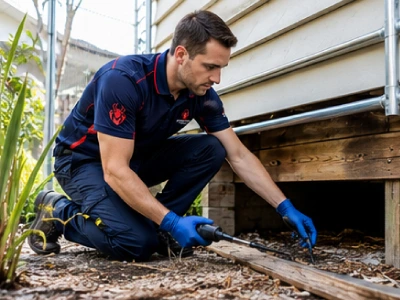
Croydon is in Maroondah a formally declared termite LGA confirmed by Termite Action Victoria and Maroondah City Council's own website. The Dandenong Ranges gateway position, 52 parks covering 13.7% of the suburb, and the Brushy Creek corridor provide extensive Coptotermes acinaciformis habitat adjacent to residential streets. Annual AS 3660.2 inspections are essential for all Croydon properties particularly the 1960s 1990s brick veneer and weatherboard homes that dominate the suburb's housing stock.
Termite inspection →
🦝 Common brushtail and ringtail possums
Abundant across all of Croydon 52 parks covering 13.7% of the suburb provide continuous possum habitat adjacent to virtually every residential street. Croydon's position as Dandenong Ranges gateway means higher-than-average possum populations from the Ranges corridor. The suburb's established 1960s 1990s homes with ageing roof tile mortar and eave linings are entered regularly. Dorset Golf Course's native vegetation and Wyreena Community Centre's historic gardens both sustain large populations adjacent to residential streets.
Possum removal →
🦟 Silverfish
Common in Croydon's older 1960s 1990s homes with original timber subfloors and unventilated bathrooms. Silverfish damage books, papers, stored clothing, and wallpaper common in Croydon's family homes with children's book collections and clothing storage. The humid subfloor conditions typical of the suburb's older brick veneer housing create year-round silverfish habitat.
Silverfish control →

Tell us a few details and our Melbourne team will get back to you quickly with the right solution.