
Pest control Doncaster
Pest control in Doncaster Manningham declared termite area, bounded by two creek corridors
Doncaster is confirmed by Manningham City Council as a declared termite area with 31 parks covering 17% of the suburb, the Koonung Creek bounding the south, and Ruffey Creek to the north. One of Melbourne's most elevated eastern suburbs at 120 metres on Doncaster Hill, and home to Westfield Doncaster, one of Melbourne's largest shopping centres. Multi Pest Control services all of Doncaster 3108.

Tell us a few details and our Melbourne team will get back to you quickly with the right solution.

Doncaster 3108
Manningham declared termite area ✓
Free Phone Consultations
Koonung Creek + Ruffey Creek corridors
25,020
residents (2021 Census)
31 parks
17% of 8.8 km² highest in this guide
120 m
Doncaster Hill one of Melbourne's highest points
15 km
Koonung Creek Trail through the suburb
Koonung Creek 15km trail corridor, south of Doncaster Road
Southern boundary
Rodents
The 15km Koonung Creek Trail confirmed by Grokipedia rats and mice travel the drainage network from the creek into residential streets south of Doncaster Road in autumn and winter.
Termites
Creek margin soils sustain permanent moisture, creating ideal Coptotermes acinaciformis foraging conditions adjacent to the residential streets bordering the creek.
Possums
Koonung Creek Reserve's riparian vegetation sustains large possum populations entering residential roofs south of Doncaster Road year-round.
Wasps
European wasps nest underground near creek reserve margins and in the embankment vegetation of the Koonung Creek Trail in the warmer months.
Ruffey Creek & Ruffey Lake Park 66–68 ha, remnant orchards, opened 1977
Northern boundary
Possums
Ruffey Lake Park (66–68 ha, confirmed Wikipedia) with remnant orchard vegetation sustains very large possum populations adjacent to Doncaster's northern residential streets.
Rodents
Ruffey Creek was dammed to create Ruffey Lake in 1974 the lake and wetland margins provide permanent water and rodent habitat adjacent to northern Doncaster streets.
Termites
Ruffey Lake Park's remnant orchard timber, native tree canopy, and moist lake-adjacent soils create the highest termite nesting conditions in the suburb.
Bird mites
Ruffey Lake's confirmed waterfowl (ducks, herons) and diverse birdlife create bird mite pressure for properties adjacent to the park's northern boundary.

🐀 Rats and mice
The 15km Koonung Creek Trail provides a continuous rodent travel corridor through Doncaster's southern boundary. Ruffey Lake's wetland margins provide permanent water and food for rodent populations in the north. Westfield Doncaster's food court bin infrastructure and loading dock areas create a major commercial rodent pressure zone in the centre of the suburb. Roof rats enter the suburb's 1960s–1980s homes through ageing eave linings year-round.
Rodent control →
🪳 German and American cockroaches
Primarily a commercial pest issue Westfield Doncaster is one of Melbourne's largest shopping centres, with food courts, restaurants, cafés, and fast food tenancies generating significant cockroach pressure in shared building infrastructure. Food businesses in Westfield require HACCP Prerequisite Program 9 documentation for City of Manningham council compliance under the Food Act 1984 (Vic). Residential infestations are less common but occur in older Doncaster kitchens near the commercial precinct.
Cockroach control →
🕷️ Redback and white tail spiders
Common throughout Doncaster's established gardens particularly in the large-lot homes adjacent to the suburb's 31 parks. Redbacks are found under outdoor furniture, letterboxes, in dry retaining walls, and in the garden structures of Doncaster's prestige properties. The suburb's elevation on Doncaster Hill also means properties on the northern slope have well-drained, dry southern aspects creating ideal redback harborage conditions.
Spider control →
🐜 Black house ants and coastal brown ants
Common in Doncaster's established 1960s–1980s homes trailing into kitchens through cracked mortar and slab edges. The suburb's 31 parks sustain large outdoor ant colonies that forage into adjacent residential properties, particularly during warmer months. The Ruffey Creek and Koonung Creek drainage areas sustain moisture-seeking ants year-round adjacent to reserve boundary streets.
Ant control →
🐝 European wasps
Nesting underground and in roof voids near Ruffey Lake Park's reserve margins, Koonung Creek embankments, and the Doncaster Municipal Gardens. Westfield Doncaster's food court outdoor areas and bin infrastructure also attract foraging wasps during summer. Peak activity February to April. Same-day removal available. Do not attempt to treat European wasp nests yourself.
Wasp removal →
🐛 Termites (Coptotermes acinaciformis)
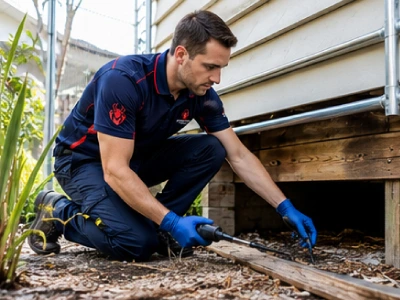
Doncaster is a confirmed declared termite area under Manningham City Council AS 3660.1 protection is mandatory for all new builds and renovations. With 31 parks covering 17% of the suburb, the Koonung Creek southern boundary, and Ruffey Lake Park to the north, the moist, tree-lined soil conditions supporting Coptotermes acinaciformis are present across the entire suburb. Annual AS 3660.2 inspections are essential for all Doncaster properties built before 2000, particularly the 1950s–1980s brick veneer and weatherboard homes that dominate the housing stock.
Termite inspection →
🦝 Common brushtail possums
Extremely abundant Ruffey Lake Park's 66–68 hectares with remnant orchard vegetation, and the Koonung Creek Reserve corridor along the south boundary, sustain one of Melbourne's largest suburban possum populations relative to suburb area. Doncaster's 1960s–1980s homes with ageing eave linings and roof tiles are entered regularly. Properties on streets adjacent to Ruffey Lake Park's southern boundary and the Koonung Creek reserve are at highest year-round possum pressure.
Possum removal →
🦟 Silverfish
Common in Doncaster's older 1960s–1980s homes with original timber subfloors and unventilated bathrooms. Doncaster's affluent, established professional community maintains large book, document, and fine textile collections all silverfish food sources. The humid subfloor conditions typical of the suburb's pre-1980 housing stock, combined with creek-corridor moisture, create year-round silverfish habitat.
Silverfish control →

Tell us a few details and our Melbourne team will get back to you quickly with the right solution.