
Pest control Balwyn
Pest control in Balwyn heritage home and high value property specialists
Balwyn's Edwardian, interwar, and post war homes on large allotments create one of Melbourne's highest concentrations of timber subfloor termite risk. Add Maranoa Gardens, Beckett Park, and the Koonung Creek corridor for sustained possum and rodent pressure and Balwyn needs a different pest approach to a new estate suburb.

Tell us a few details and our Melbourne team will get back to you quickly with the right solution.

Balwyn 3103
Edwardian & interwar home specialists
Free Phone Consultations
Maranoa Gardens & Koonung Creek zone
13,495
residents (2021 Census)
10 km
from Melbourne CBD
19 parks
5.0% of 4.4 km² suburb
Median age 43
one of Melbourne's most affluent suburbs
Timber on brick piers, original subfloor
Edwardian (1900–1920)
High termite risk
Original hardwood floors, bearers and joists on brick piers. Subfloor crawl spaces with decades of moisture accumulation. No termite barrier — built long before AS 3660. Highest termite vulnerability of any Balwyn housing era.
California bungalows Reid Estate heritage area
Interwar (1920–1945)
Elevated termite risk
Predominantly timber subfloor on brick stumps, original roof framing. The Reid Estate Heritage Overlay between Mont Albert and Whitehorse Roads contains a high concentration of architecturally significant interwar homes all with original timber subfloor. Annual inspection critical.
Brick veneer, partial subfloor
Post-war (1945–1980)
Moderate termite risk
Mix of timber subfloor and early slab construction. Chemical soil treatments from this era have long expired. Many large Balwyn allotments have 1950s–1970s homes with original subfloor crawl spaces still intact. Annual inspection recommended.
Slab on ground, recent construction
Modern (post-1980)
Lower but present risk
Slab construction eliminates subfloor entry but termites can still enter through expansion joints, pipe penetrations, and landscaping in contact with the structure. New Balwyn townhouses should have a current barrier in place check documentation.

🏠 Edwardian homes (1900–1920)
Original timber subfloor on brick piers, wide verandahs, casement windows, decorated eaves. Some of Balwyn's oldest homes high termite and silverfish risk due to original timber construction and decades of subfloor moisture. Possum entry through deteriorating eave linings. Highest pest risk category in the suburb.
🏡 Interwar California bungalows (1920–1945)
The dominant heritage housing type in Balwyn large allotments, timber subfloor, deep roof voids. The Reid Estate Heritage Overlay (HO192) contains a high concentration. Wide eave overhangs and deep subfloors create ideal termite and possum harborage. Architecturally significant require careful inspection to avoid heritage fabric damage.
🏘️ Post-war brick veneer (1945–1975)
Widespread across the suburb on larger Balwyn allotments. Mix of timber subfloor and early slab. Any chemical soil treatment from construction has long expired. Established gardens some 50+ years old create significant possum, spider, and ant harborage. Moderate to elevated pest risk depending on subfloor type.
🏗️ Contemporary renovations & townhouses
Increasing as older homes are renovated or subdivided. Renovation works disturb established rodent and cockroach populations. New townhouses on slab may not have current termite barrier documentation buyers should request this. Lower inherent termite risk than original stock but renovation displacement risk is high.
🏫 Schools (Balwyn High, Fintona, Deepdene Primary)
Balwyn High School, Fintona Girls' School, Balwyn Primary School, and Deepdene Primary School all within or adjacent to the suburb. Large campus buildings, canteens, and outdoor eating areas require scheduled pest programs. Older school buildings may have timber subfloor structures with termite risk.
🎬 Balwyn Cinema (Palace Cinemas heritage Art Deco)
Opened 1930, now 11 screens. Heritage Art Deco building. Food service, large patron volumes, and shared walls with adjacent retail. Cockroach and rodent management required for the food service areas and bin enclosures. Heritage building constraints apply to any treatment accessing original fabric.
🐀 Rats and mice
The Koonung Creek drainage corridor along Balwyn's northern boundary is the primary rodent pressure source rats travel the creek drain network into Balwyn Road, Belmore Road, and the northern residential streets in autumn and winter. Roof rats enter through gaps in ageing roof tiles and eave linings in the Edwardian and interwar homes. The large gardens of Balwyn's prestige properties provide extensive rodent cover and food from fruit trees and compost.
Rodent control →
🪳 German and American cockroaches
Less common in Balwyn's residential homes than in inner city suburbs, but significant in the food service areas of Whitehorse Road commercial precinct the Balwyn Palace Cinema food service, cafés, and restaurants near the intersection of Whitehorse Road and Balwyn Road. Residential cockroach activity is highest in Balwyn's older kitchens that have not been recently renovated.
Cockroach control →
🕷️ Redback and white tail spiders
Common in Balwyn's large established gardens particularly under outdoor furniture, in dry rockeries, and behind garden structures on the suburb's prestige properties. The deep subfloor spaces of Edwardian and interwar homes are prime harborage for white-tail spiders feeding on silverfish and other subfloor insects. Balwyn's large block sizes mean more garden area and more potential harborage than in inner-city suburbs.
Spider control →
🐜 Black house ants and coastal brown ants
Trailing into kitchens along slab edges and through cracks in older mortar particularly common in the post-war brick veneer homes where original mortar is deteriorating. Balwyn's large gardens sustain large outdoor ant colonies that forage into adjacent properties. Established fruit trees common in Balwyn's large-lot homes are significant ant attractors.
Ant control →
🐝 European wasps
Nesting in wall cavities and underground in Balwyn's established gardens, particularly near Beckett Park and the Maranoa Gardens boundary. The deep eave spaces of interwar bungalows are also a common wasp nesting location in Balwyn. Peak activity February to April same day emergency nest removal available.
Wasp removal →
🐛 Termites (Coptotermes acinaciformis)
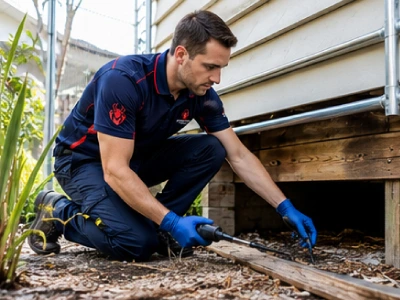
Balwyn is one of Melbourne's eastern suburbs with genuine elevated termite risk. The suburb's extensive pre-1980 housing stock with original timber subfloor construction combined with the mature tree canopy of Maranoa Gardens, Beckett Park, and the Outer Circle Linear Park providing Coptotermes acinaciformis nesting habitat creates the conditions for significant termite activity. Annual AS 3660.2 inspections are essential for any Balwyn property built before 1980.
Termite inspection →
🦝 Common brushtail possums
Abundant in Balwyn sustained by Maranoa Botanic Gardens (2.6 hectares of mature native Australian flora), Beckett Park (bushland atop the suburb's highest ridge), and the Koonung Creek Reserve. Balwyn's large allotments have mature trees overhanging rooflines, giving possums easy access to roof voids. Older homes with deteriorating eave linings are entered almost without effort. One of Balwyn's most frequent residential pest complaints.
Possum removal →
🦟 Silverfish
Very common in Balwyn's older homes particularly in timber subfloor areas, original bathroom tiles with grout moisture, and the extensive book and document collections common in Balwyn's professional and academic households. Original Edwardian and interwar homes with timber subfloors have the highest silverfish activity of any Melbourne suburb type. Silverfish cause significant damage to books, papers, and stored textiles.
Silverfish control →

Tell us a few details and our Melbourne team will get back to you quickly with the right solution.